Cremation now accounts for more than 60% of dispositions in the United States and is climbing past 75% in Canada, according to data from the National Funeral Directors Association and the Cremation Association of North America. For cemetery operators, that shift has quietly become the single largest driver of product mix decisions and nowhere is the decision sharper than the choice between glass-front and granite front niches.
Both are legitimate, long established products. Both command premium pricing compared to ground interment. But they are not interchangeable. They attract different families, generate different revenue per square foot, carry different installation economics, and occupy different places in a well-designed columbarium program.
This guide compares them on the metrics that actually matter to cemetery GMs and development committees: retail price, demand, cost to install, maintenance, and long-term revenue per square foot.
Quick Comparison at a Glance
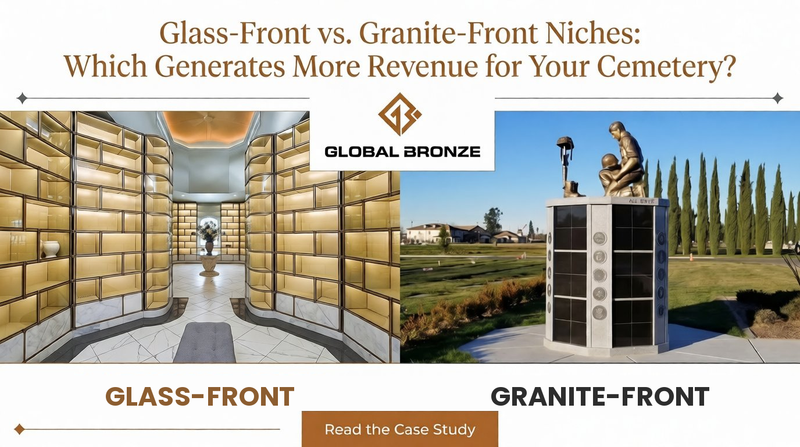
| Factor | Glass-Front Niches | Granite-Front Niches |
|---|---|---|
| Installed cost per niche | Comparable to granite — similar build economics | Comparable to glass — similar build economics |
| Typical retail price | Higher — often commands a 10% to 30% premium | Lower retail baseline, but strong margins |
| Placement | Indoor only (mausolea, chapels, niche walls) | Indoor or outdoor |
| Personalization | Urns, photos, mementos visible inside | Letters, engraved nameplate, EZ-Plaques™, emblems, lights, vases, photoceramics and frames |
| Customer demand trend | Fastest-growing niche category in North America | Steady, traditional demand |
| Revenue per square foot | Highest of any interment product | Strong, but lower than glass |
| Privacy | Low — contents visible to all visitors | High — fully opaque |
| Maintenance burden | Moderate — glass cleaning, interior dust | Low — weatherproof, minimal upkeep |
| Best fit | Revenue-focused mausoleum expansions, chapels, indoor retrofits | Outdoor columbaria, traditional gardens, privacy-focused markets |
The Revenue Case for Glass-Front Niches
Glass-front niches are the fastest growing category of interment product in North America, and there is a simple reason: they sell for more, they sell faster, and they keep selling at higher average prices as the columbarium matures.
The mechanics are straightforward. A glass-front niche is not really competing against granite. It is competing against a family's desire to put a loved one on the mantelpiece. Scattering, home urns, and keepsake jewelry are all pulling cremated remains away from cemeteries entirely. A glass fronted niche pulls them back, because it offers something none of those alternatives can: a visible, personalized, permanent tribute the family can visit and decorate.
That emotional pull translates directly into price tolerance. At-need and pre-need counselors consistently report that families who walk in expecting to purchase a $2,000 ground plot will sign for a $4,500 glass-front niche once they see one. Premium positions within a glass fronted wall eye level rows, corner units, and curved-glass features can command an additional 20% to 60% over standard interior rows.
For a cemetery, the revenue per square foot math is decisive. A single glass front niche wall that occupies roughly 50 square feet of floor space can hold 60 to 100 niches, each selling for several thousand dollars. The same 50 square feet of outdoor ground inventory might hold 12 to 15 plots at a lower price point, with longer sell through. The glass front wall generates multiples of the revenue in a fraction of the footprint.

Where Granite-Front Niches Still Win
None of this means granite is a secondary product. Granite-front niches remain the right choice in several clearly defined scenarios, and cemeteries that abandon granite to chase glass-front revenue often discover they have alienated an important segment of their market.
- Outdoor columbaria. Glass front construction is not practical outside. Weather, UV exposure, and thermal cycling make outdoor glass fronts a maintenance headache and an aesthetic liability. Every outdoor columbarium your cemetery builds will be granite front, bronze front, or marble front. Period.
- Privacy-focused markets. A meaningful percentage of families often driven by religious tradition, cultural preference, or simple personal reserve do not want the contents of their loved one's niche visible to other visitors. Granite offers a dignified, opaque alternative. In many Catholic, Orthodox Christian, Jewish, and Muslim cemeteries, granite remains the dominant request.
- Lower retail price points. Granite niches let cemeteries serve families who want an affordable, dignified option at a lower retail price than glass. Even though build costs are comparable, granite's traditional, private aesthetic allows it to sit at a lower price tier in the program and reach families who would not otherwise buy into a columbarium.
- Durability in demanding conditions. In freeze thaw zones, coastal salt air, or regions with extreme temperature swings, granite is simply the more forgiving material over a hundred-year lifespan.

The Cost Side: What Operators Should Know
Revenue is half the equation. The other half is the cost to build, install, and maintain each product and here is where most cemetery operators are surprised.
The installed cost of a glass-front niche and a granite-front niche is comparable. Both products require engineered framing, a finished façade, sealing and hardware, and skilled installation. The line items shift glass niches carry the cost of tempered or beveled glass and integrated lighting, while granite niches carry the cost of the stone itself, shutter fabrication, and rosette hardware but the totals land close to each other. On a typical project, the cost differential per niche runs in the range of $100 to $200, not thousands.
That changes the math completely. The decision between glass and granite is not a cost decision. It is a revenue, placement, and customer preference decision. When the build cost is roughly the same but the retail price of a glass-front niche runs 10% to 30% above an equivalent granite front niche and premium glass positions can command far more the margin differential is almost entirely a pricing opportunity rather than a cost trade off.
Install time favors modern fiberglass based systems dramatically. Traditional poured-concrete mausoleum construction can take months and requires deep foundations. Global Bronze's EZ-Mausolea™ and EZ-Columbaria™ systems are custom built and ready for installation within 60 days, with most small to medium projects completing on-site in approximately one week. Larger or more complex builds will vary, but the timeline is a fraction of conventional poured construction. That speed compresses the time between capital outlay and first sale for both glass front and granite front builds.
Maintenance is the category where granite quietly wins. A granite front niche requires essentially no upkeep beyond occasional cleaning. A glass front niche needs periodic interior dusting, glass cleaning, and depending on the seal quality of the system occasional attention to humidity control. A well engineered sealed fenestration system minimizes this burden, but it never eliminates it.
Customer Demand: What Families Actually Want
Three trends in family preference have held steady across North America for the past decade.
First, families increasingly want a visible place to grieve. Ground plots and opaque niches serve the deceased; glass-front niches serve the living. The ability to bring children and grandchildren to a space that contains recognizable objects a wedding photograph, a military cap, a grandmother's rosary is a powerful driver of purchase.
Second, personalization is no longer optional. Every major industry study from CANA and NFDA in recent years has highlighted the growing expectation of personalization in memorialization. Glass front niches accommodate this expectation natively. Granite front niches accommodate it through engraving, emblems, and bronze attachments effective, but more constrained.
Third, families are willing to pay for distinction. A standard interior row niche sells. A curved glass corner niche, or a lighted feature niche at the entrance of a chapel, sells faster and at a meaningful premium. The more differentiation your columbarium offers, the more price points your sales team can work with.

The Right Answer for Most Cemeteries: Both
The single biggest mistake we see cemetery operators make is treating glass front and granite front niches as competitors in their own inventory. They are not. They serve different families, different price points, different settings, and different emotional needs.
A well-designed columbarium program typically includes:
- An indoor glass front niche wall or niche chapel as the revenue engine, ideally with feature elements (curved glass, corner units, lighted pyramids) at premium pricing
- A granite front indoor option for families who prefer privacy or a lower price point
- An outdoor granite, bronze, or marble front columbarium for the traditional garden setting
- Bronze emblems, vases, and plaque accessories available across all product lines, so every niche has an upsell path
Cemeteries that offer the full spectrum capture more families, hold more price points, and avoid the trap of turning away a customer because the only product on offer doesn't match what they want.
Making the Decision for Your Property
If you are evaluating which direction to take on your next capital project, a few grounding questions tend to produce the clearest answer.
What percentage of your current interments are cremations, and what direction is that number trending? If cremation is above 50% of your volume and still climbing, the case for expanding glass front inventory is strong.
Do you have unused or underused indoor space an existing mausoleum wall, a chapel alcove, a storage area that could be converted? Glass front retrofits into existing structures are among the highest ROI capital projects in the cemetery industry.
What is your sold out position on your current granite front inventory? If families have been waiting for new niche inventory, the market is already signalling demand.
What does your competition in a 30 mile radius offer? If no nearby cemetery has a glass front niche chapel, being first to market is a durable advantage. If several do, the question becomes how to differentiate curved glass, lighting, architectural distinction, bronze accessory programs.
Frequently Asked Questions
How much do glass-front niches cost compared to granite-front niches?
The installed cost is comparable. Typical cost differentials run in the range of $100 to $200 per niche, not thousands. The meaningful gap is on the retail side: glass front niches typically sell for 10% to 30% more than equivalent granite front niches, and premium positions (corner, curved glass, lighted feature) can command significantly more. Because build costs are similar but retail prices diverge, the margin advantage of glass is almost entirely a pricing opportunity rather than a cost trade off.
Can glass-front niches be installed outdoors?
No, not practically. Outdoor weather, UV exposure, and thermal cycling make glass front construction impractical for exterior use. Outdoor columbaria use granite, bronze, or marble fronts. Glass front niches belong inside mausolea, chapels, and niche walls.
Are glass-front niches secure?
Modern glass front niche systems use tempered glass, tamper resistant fasteners, and sealed fenestration. A well engineered system is as secure as any traditional niche front. Global Bronze systems use sealed fenestration with anodized aluminum framing designed for both security and long term durability.
How long does it take to install a glass front niche wall?
Custom built and ready for installation within 60 days. Timelines vary by project size most small to medium installations are completed in approximately one week, while larger projects depend on scope and complexity.
Do glass-front niches generate more revenue than ground burial?
Yes, significantly. On a revenue per square foot basis, glass front niches generate multiples of the revenue of ground plots, because each square foot of floor space can accommodate many stacked niches rather than a single ground interment.
What maintenance do glass front niches require?
Periodic cleaning of the glass fronts and occasional interior dusting are the main requirements. Quality systems include sealed fenestration to manage humidity and dust ingress, minimizing the maintenance burden.
Should my cemetery offer both glass front and granite front niches?
In almost all cases, yes. The two products serve different families, different price points, and different settings. Offering only one segments out a meaningful portion of your market.
Planning Your Next Columbarium Project
Global Bronze has designed, manufactured, and installed memorialization products for more than 500 cemeteries and funeral partners across North America, with over 1,000 installations and more than 5 million memorial units delivered. We work with cemetery operators from initial site survey through design renderings, ROI projections, manufacturing, and installation indoor or outdoor, glass front or granite, new build or retrofit.
If you are evaluating a columbarium expansion, a mausoleum retrofit, or a new niche chapel, our team can help you model the revenue potential of different product mixes on your specific site and walk you through the construction and installation timeline.
Plan your project with Global Bronze →
Global Bronze Inc. is a manufacturer of innovative memorialization products, serving cemeteries, funeral homes, churches, and monument builders across North America since 1989. Recognized as one of North America's leading producers of glass fronted niches, our patented EZ-Mausolea™, EZ-Columbaria™, and EZ Mini-Mausolea™ systems, together with our FibreBronze™ and FibreMarble™ composite materials, have set new standards for durability, installation speed, and architectural flexibility in the memorialization industry.